
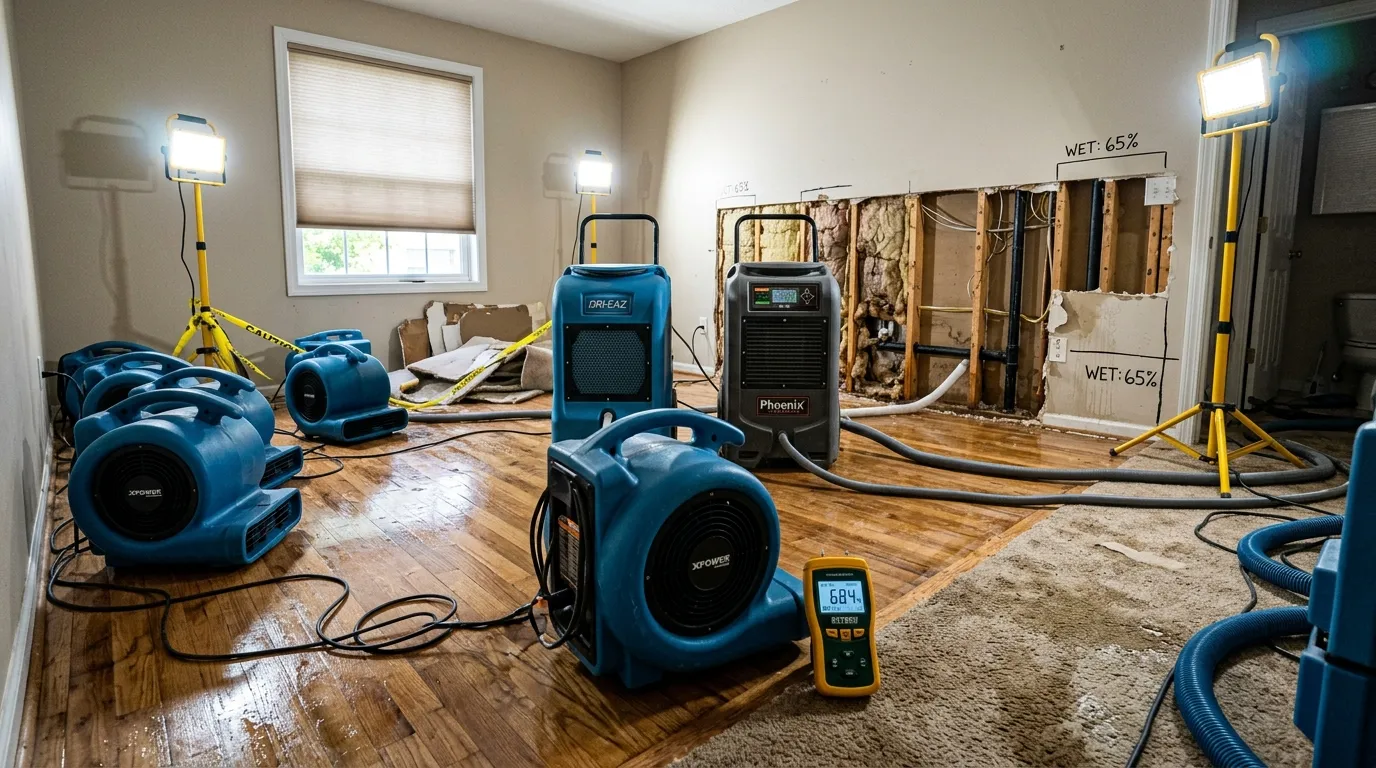
Water Damage Restoration in Madison
Expert water damage restoration in Madison and surrounding areas. Family-owned, licensed & insured since 2008. Call (256) 771-0326.
What happens in the first 24 hours matters more than anything else
Water doesn’t wait. Within an hour of a pipe burst or appliance failure, it migrates through drywall, under hardwood, and into subfloor cavities you can’t see. Within 24–48 hours, wet cellulose materials become a viable environment for mold colonization. The goal of water damage restoration isn’t just removing the water you can see — it’s finding and eliminating the moisture that’s already moved somewhere else, then drying the structure down to pre-loss moisture content before secondary damage sets in.
What water damage restoration actually involves
Effective water damage restoration is a science-driven process, not a shop-vac and a few fans. The work breaks into two distinct phases: mitigation (stopping the damage from getting worse) and drying (returning the structure to a stable, dry state).
On arrival, technicians use thermal imaging cameras and non-invasive moisture meters to map exactly where water has traveled — often into wall cavities, beneath tile, or into insulation that looks dry from the outside. That mapping drives every decision that follows.
Extraction comes first. Truck-mounted or portable extraction units pull standing water from floors and carpet at a rate that box fans simply can’t match. After bulk water removal, the real work begins: industrial-grade desiccant or refrigerant dehumidifiers, air movers positioned at calculated angles, and in some cases drying mats for hardwood or injectables for wall cavities. Equipment isn’t placed randomly — it’s engineered to create a specific airflow pattern that drives evaporation out of the material and into the air, where dehumidifiers capture it.
Moisture readings are logged daily. Drying typically takes 3–5 days for Category 1 (clean water) losses in a well-ventilated structure; Category 2 or 3 losses — sewage backup, floodwater, or any water that’s been sitting — take longer and require containment protocols to protect unaffected areas.
Our process
1. Rapid response and water source control Before anything is extracted, the source has to be stopped. That means coordinating with your plumber if a supply line is still running, or documenting the entry point for storm-driven water. We identify the water category (clean, gray, or black) on arrival — that classification determines the safety protocols and disposal requirements for everything we remove.
2. Moisture mapping and documentation Thermal imaging and calibrated moisture meters establish a baseline reading for every affected material. This documentation isn’t just for our process — it’s the evidence your insurance adjuster needs to authorize the full scope of work. Skipping this step is one of the most common ways homeowners end up with an underpaid claim.
3. Water extraction High-capacity extractors remove standing water and pull moisture from carpet, pad, and porous flooring. Depending on the loss, we may recommend removing carpet pad — it holds water like a sponge and rarely dries in place without creating a mold risk beneath it.
4. Structural drying with daily monitoring Air movers and dehumidifiers are placed according to a drying plan, not guesswork. We return daily to log moisture readings, adjust equipment placement, and document progress. Drying is complete when affected materials reach the target moisture content for your region’s ambient conditions — not just when things feel dry to the touch.
5. Controlled demolition if needed Sometimes drying in place isn’t possible. Wet insulation, saturated drywall below the flood cut line, or swollen subfloor panels may need to come out to allow the structure to dry and to prevent hidden mold growth. We document everything removed for your insurance scope.
What separates a good water damage response from a bad one
The most common failure in water damage restoration is stopping too early. A crew that extracts visible water, drops a few fans, and calls it done in two days is almost certainly leaving elevated moisture in wall assemblies, under flooring, or in structural members. That moisture doesn’t announce itself — it quietly feeds mold for weeks until you smell it.
A few specific things experienced operators do differently:
- They read moisture, not just surface appearance. Hardwood can look flat and feel firm while the subfloor beneath it reads 25% moisture content — well above the threshold for mold growth.
- They document for insurance from day one. Adjusters want to see moisture logs, equipment placement records, and photos of affected materials before demolition. Operators who skip documentation leave homeowners without the evidence to support a full claim.
- They classify water correctly. Category 3 water (sewage, groundwater, floodwater) requires personal protective equipment, antimicrobial treatment, and specific disposal protocols. Treating it like a clean-water loss creates health risks and potential liability.
- They don’t oversell demolition — or undersell it. Unnecessary tear-out inflates claims; insufficient tear-out leaves wet material behind. The right call is driven by moisture readings, not by what’s faster or cheaper.
Seasonal and regional considerations
Madison and the broader Tennessee Valley sit in a climate that creates specific water damage risks by season. Winter freeze events — relatively rare but severe when they hit — cause sudden pipe bursts in homes with exterior or crawlspace plumbing that wasn’t insulated for hard freezes. Spring brings heavy rainfall that tests sump pumps and crawlspace drainage systems; crawlspace flooding is one of the most underreported water losses in this region because homeowners don’t check down there until they smell something. Summer humidity in North Alabama means ambient moisture levels are already elevated, which extends drying times and makes containment more important for Category 2 and 3 losses.
Service area
Davis Construction Contractors is based in Madison, AL and responds to water damage losses throughout the surrounding area, including Huntsville, Athens, Decatur, and other communities across North Alabama. Dedicated service-area pages cover the specific neighborhoods and response considerations for each city.
If you’re standing in a wet room right now, call (256) 771-0326 to schedule your moisture assessment. The sooner we can map where the water has gone, the better your chances of avoiding secondary damage — and the stronger your documentation will be when you file your claim.
Frequently Asked Questions
How long does structural drying typically take, and does the water category affect the timeline?
What's the difference between Category 1, Category 2, and Category 3 water, and why does it matter for cleanup?
What should I do — and not do — while waiting for the restoration crew to arrive?
Can wet hardwood floors be dried in place, or do they always need to come out?
How does moisture documentation affect my insurance claim for water damage?
Looking for the best water damage restoration company in Madison?
Davis Construction Contractors provides water damage restoration in Madison, AL and the surrounding area, and has served local property owners since 2008. Call (256) 771-0326 during business hours (Monday–Friday, 8:00 AM – 5:00 PM) for a free estimate.
Need Water Damage Restoration now?
We serve Madison and surrounding AL cities — family-owned, licensed & insured.
Related Coverage
- Our Restoration Services
- Contact Davis Construction Contractors
- Water Damage Restoration in Athens
- Water Damage Restoration in Huntsville
- Burst Pipe Emergency Checklist: Step-by-Step Response
- What To Do in the First 24 Hours After Water Damage
- How To Choose a Restoration Company in (Without Getting Burned)