
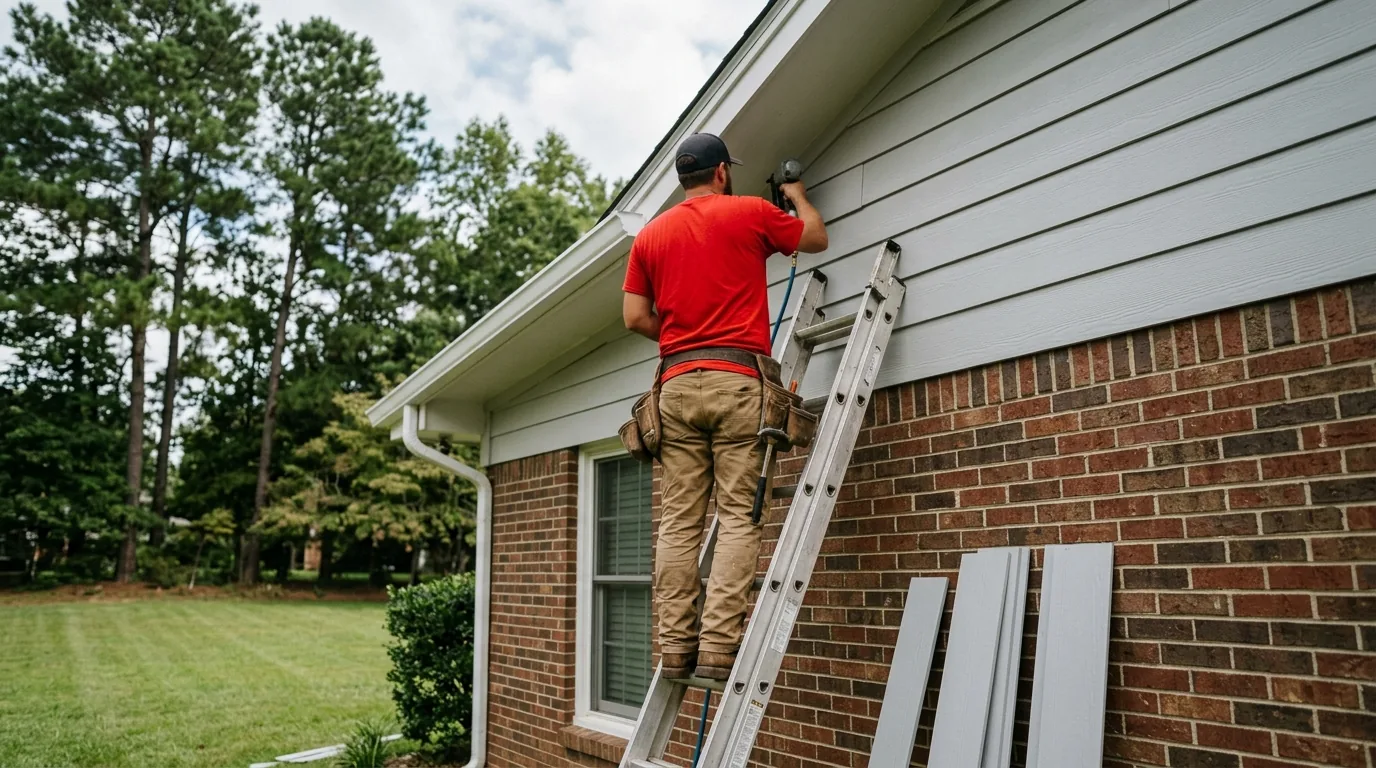
Siding and Gutters in Madison
Professional siding and gutters in Madison and surrounding areas. Family-owned, licensed & insured since 2008. Call (256) 771-0326.
Rotting fascia behind a clogged gutter. Buckled vinyl panels where water worked its way behind the flashing. Paint peeling off the trim two years after a “fresh” exterior job because the installer skipped the moisture barrier. These aren’t cosmetic annoyances — they’re entry points for water, insects, and heat loss that compound every season they go unaddressed. Siding and gutter work done right seals the building envelope; done wrong, it quietly funds the next water damage or mold remediation call.
What siding and gutter work actually involves
A siding project is more than nailing panels to a wall. It starts with what’s underneath: house wrap or felt paper, proper flashing at windows and penetrations, and a substrate that’s actually sound. On older Madison-area homes — many built in the 1970s and 80s with T1-11 or original wood lap siding — that substrate is often compromised before the first new panel goes up. Replacement means pulling the old material, inspecting and repairing sheathing, installing a continuous weather-resistive barrier, then hanging new fiber cement, engineered wood, or vinyl with correct overlap, fastener spacing, and expansion gaps.
Gutter work runs parallel. A properly sized gutter system (typically 5-inch K-style for residential, 6-inch for steeper or larger roofs) has to be pitched correctly — roughly a quarter inch of drop per 10 feet of run — or water pools, overflows, and eventually undermines the fascia board it’s mounted to. Downspout placement, underground drainage routing, and gutter guard selection all factor into whether the system actually moves water away from the foundation.
A full exterior replacement on a 2,000-square-foot home typically runs 3–7 days depending on substrate condition, story height, and trim complexity. Gutter-only jobs on a standard single-story home are usually a one-day installation.
Our process
-
Exterior inspection and substrate assessment. Before any material is ordered, we walk the full perimeter, probe fascia boards for soft spots, check existing flashing at windows and roof transitions, and document any sheathing damage with photos. This step determines whether the job is a straight swap or requires rot repair and sheathing replacement — a distinction that affects both timeline and cost.
-
Material selection and measurement. We take precise linear footage and square footage measurements, calculate waste factors for cuts and corners, and confirm material lead times. For siding, we discuss profile options (lap, board-and-batten, shake), color, and manufacturer warranty terms. For gutters, we size the system to roof pitch and drainage area, not just to what was there before.
-
Tear-off and substrate preparation. Existing siding comes off in sections. Any damaged sheathing is replaced, penetrations are re-flashed, and a new house wrap is installed with taped seams. On gutter replacements, old hangers and spikes are removed, fascia is repaired or replaced where needed, and mounting surfaces are cleaned before new hangers go in.
-
Installation and flashing integration. Siding panels are installed per manufacturer specs — correct fastener type, proper nailing zone, expansion gaps at corners and openings. Window and door trim is integrated with kick-out flashing and sill pan flashing, not just caulked over. Gutters are hung on hidden hanger systems, pitched to spec, and sealed at miters and end caps before downspouts are cut and fitted.
-
Final inspection and water test. We run a hose test on completed gutter runs to confirm pitch and check for leaks at seams. Siding is inspected for consistent reveal, secure fastening, and proper caulking at all penetrations. Cleanup includes magnet sweep for fasteners and full debris removal from the site.
What separates a good exterior job from a bad one
The most common failure point in siding installation isn’t the panel — it’s the flashing. Water that gets behind siding at a window head or a roof-wall transition will travel horizontally inside the wall cavity for feet before it shows up as a stain or a soft floor. Installers who skip step flashing at dormers, use caulk as a substitute for kick-out flashing, or lap house wrap the wrong direction (bottom over top instead of top over bottom) create problems that won’t surface for 18 to 36 months — long after the crew is gone.
On the gutter side, the most common mistakes are undersized downspouts for the drainage area, gutters pitched back toward the fascia instead of away, and end caps that are sealed with caulk alone rather than pop-riveted and sealed. Spike-and-ferrule hangers — still common on homes built before 2000 — pull out of fascia over time and should be replaced with screw-in hidden hangers during any gutter replacement.
Insurance adjusters documenting storm damage look specifically for hail impact marks on siding (circular dents or cracks at fastener points on vinyl, dings on fiber cement), gutter dents and displaced downspouts, and damaged fascia. Photo documentation of these before tear-off is critical for a complete claim.
Seasonal and regional considerations
North Alabama’s climate creates a specific set of exterior challenges. Summers bring sustained heat and UV exposure that accelerates chalking and fading on lower-grade vinyl siding. Late-spring storm systems — the same ones that produce hail and high winds across the Tennessee Valley — are the leading driver of insurance-related siding and gutter claims in the Madison area. Fall is the practical installation window: temperatures are moderate, crews aren’t fighting heat expansion in the panels, and getting new gutters in place before winter rainfall protects the foundation through the wet season.
Ice damming is less common here than further north, but it does occur during hard freezes, and gutters already sagging from debris load are the first casualty.
Service area
Davis Construction Contractors is based in Madison, AL and serves the surrounding area including Huntsville, Athens, Decatur, Harvest, and Hampton Cove. Dedicated service pages for each city are linked throughout this site.
If your siding is showing gaps, buckling, or moisture staining — or your gutters are pulling away from the fascia — call (256) 771-0326 to schedule an exterior inspection. We’ll document what’s there, tell you what needs to happen, and give you a written scope before any work begins.
Frequently Asked Questions
What's the difference between repairing a section of siding versus replacing it entirely, and how do you decide which is appropriate?
What siding materials perform best in North Alabama's climate, and what are the trade-offs?
How is gutter sizing determined, and why does it matter?
If a storm damages my siding and gutters, what should I document before calling a contractor?
How long should a quality siding installation last, and what typically shortens that lifespan?
Looking for the best siding and gutters company in Madison?
Davis Construction Contractors provides siding and gutters in Madison, AL and the surrounding area, and has served local property owners since 2008. Call (256) 771-0326 during business hours (Monday–Friday, 8:00 AM – 5:00 PM) for a free estimate.
Need Siding and Gutters now?
We serve Madison and surrounding AL cities — family-owned, licensed & insured.