
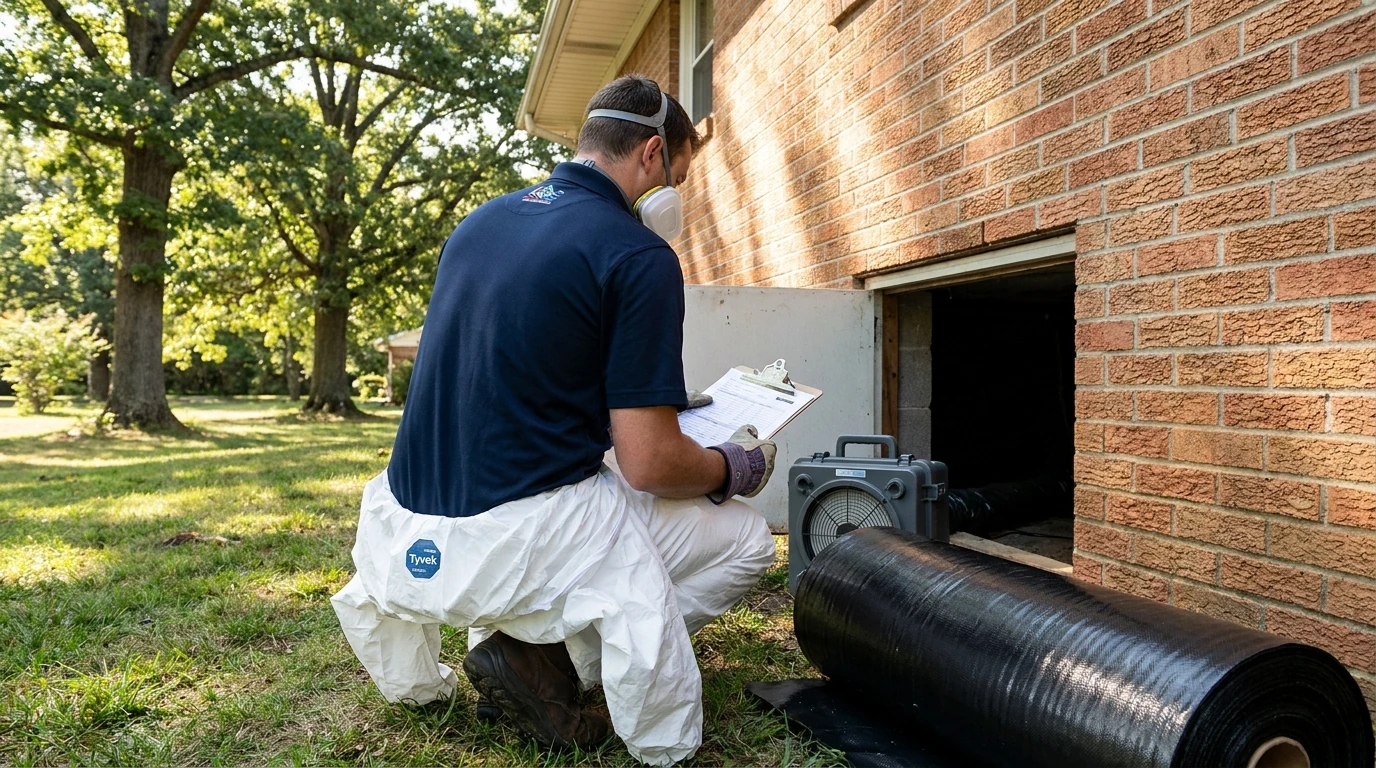
TL;DR: Crawl space mold in Madison, AL is driven by the region’s hot, humid summers pushing moisture-laden air into vented crawl spaces under your home. Removal typically costs $1,500–$6,000 depending on the affected area, and encapsulation is the most reliable way to prevent recurrence. Left untreated, crawl space mold spreads to floor joists, subfloor sheathing, and eventually affects indoor air quality throughout the house.
If you’ve noticed a musty smell coming up through your floors, or a home inspector flagged mold during a sale in Liberty Park or Bradford Creek, you’re dealing with one of the most common issues in North Alabama housing. Madison’s summers push outdoor humidity into the 80–90% relative humidity range for weeks at a time. Vented crawl spaces, the standard design in most of the 1970s–80s ranch homes and even many 2000s builds in this area, pull that saturated air in and hold it against cool wood framing. That’s a perfect mold incubator, and it runs all summer without anyone noticing.
What Are the Signs of Crawl Space Mold?
The clearest signs of crawl space mold are a persistent musty odor inside the home, visible dark spotting or fuzzy growth on floor joists or subfloor sheathing, and soft or springy spots in your flooring above the crawl space. You may also notice increased allergy symptoms or worsening asthma, particularly in ground-floor rooms.
Other signs worth checking:
- Standing water or damp soil after rain. Bradford Creek area homes and those near the County Line Road corridor can see groundwater intrusion after heavy spring storms.
- Efflorescence on the foundation walls, the white chalky deposits that form when water moves through concrete block.
- Condensation on HVAC ducts running through the crawl space. When cold duct surfaces meet humid air, moisture collects and drips onto the soil below.
- Rust on metal fasteners in the crawl space framing, a reliable indicator that relative humidity has been consistently above 70%.
If you’re not sure whether what you’re seeing is mold or just dirt and staining, a surface swab test or air quality sample can confirm it. The EPA’s guidance on mold in homes is a useful reference for understanding when testing is warranted versus when visible growth is enough to act on.
For a broader look at how to distinguish mold types, see our post on black mold vs regular mold, the identification principles apply to crawl space growth as much as they do to interior walls.
Why Is Humidity So High in Madison Crawl Spaces?
North Alabama’s climate creates crawl space humidity problems because warm outdoor air holds far more moisture than cool crawl space air, and traditional vented crawl spaces are designed to exchange that air constantly. In a dry climate, that ventilation strategy works. In Madison’s humid summers, it backfires.
Here’s the physics in plain terms: when 90°F outdoor air at 80% relative humidity enters a crawl space and cools to 70°F, its relative humidity climbs above 100%, meaning it deposits liquid water on every surface it touches. Wood framing, insulation batts, and soil all absorb that moisture. Once wood-moisture content exceeds roughly 19%, mold spores that are always present in the air can germinate and begin growing within 24–48 hours.
Several factors make Madison homes particularly vulnerable:
- Older vented crawl space designs. Homes built before the 2012 International Residential Code updates often have foundation vents that were sized to an older ventilation formula, one square foot of vent area per 150 square feet of crawl space floor. That formula was written for drier climates and actively worsens humidity in the Southeast.
- Bare soil floors. Many crawl spaces in the area have no vapor barrier, or have an old 6-mil poly sheet that has torn and shifted over the years. Soil releases moisture continuously, and without a proper barrier it goes straight into the air.
- HVAC equipment in the crawl space. Duct leaks and condensate drips add moisture load on top of what’s already coming in through the vents and soil.
- Inadequate drainage grading. Homes where the soil slopes toward the foundation, common in older subdivisions around Old Town Madison, allow rain runoff to pool near the foundation wall and wick inward.
How Is Crawl Space Mold Removed?
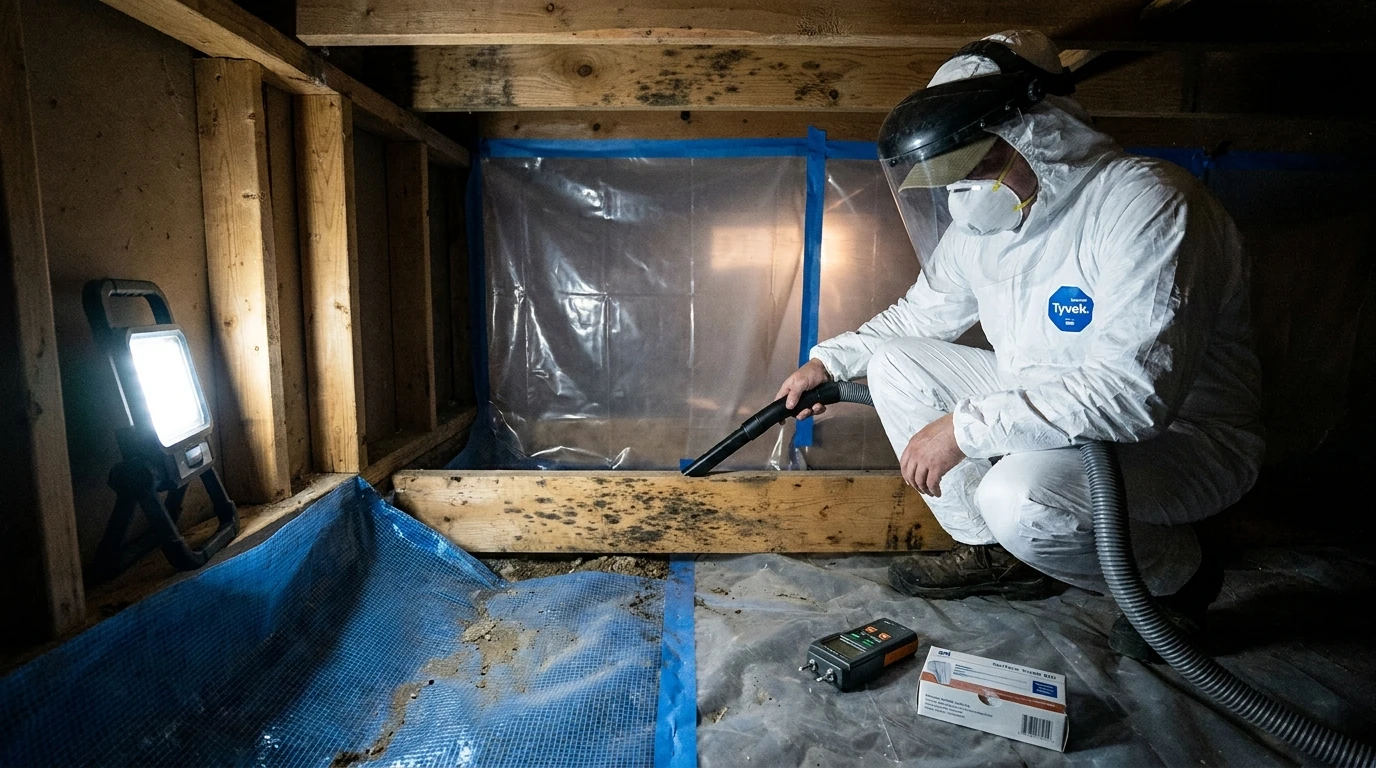
Crawl space mold removal follows a specific sequence: contain the work area, remove or treat affected materials, address the moisture source, and verify clearance. Skipping the last step, or the second-to-last, is why mold comes back.
Step 1: Containment. Before any disturbance, the crawl space access is sealed with poly sheeting and negative air pressure is established using a HEPA air scrubber. This prevents spores from migrating into the living space during removal. Workers wear full Tyvek suits, N95 or P100 respirators, and face shields.
Step 2: Material removal or treatment. Heavily colonized wood, typically framing members with deep surface penetration, may need to be removed and replaced. More commonly, affected joists and sheathing are treated with an EPA-registered fungicide, wire-brushed or media-blasted to remove surface growth, and then coated with an encapsulant borate solution that inhibits future growth. The EPA’s registered pesticide database lists approved fungicidal products for structural wood treatment.
Step 3: Source correction. This is the step that determines whether the mold comes back. Removing the growth without fixing the humidity is like mopping a floor with the faucet still running. Source correction typically includes:
- Installing a new 20-mil reinforced vapor barrier over the soil, sealed to the foundation walls
- Sealing or closing foundation vents (in a conditioned crawl space approach)
- Adding a crawl space dehumidifier sized to the space
- Correcting any active water intrusion, downspout extensions, grading, or French drain installation if needed
Step 4: Post-remediation verification. Air sampling or surface swabs confirm that spore counts are back to normal background levels before containment is removed. Reputable contractors provide a written clearance report.
For cost context specific to Madison, our mold remediation cost guide breaks down pricing by scope and square footage.
What Does Crawl Space Mold Removal Cost in Madison, AL?
Crawl space mold removal in Madison typically runs $1,500–$6,000 for the remediation work itself, with encapsulation adding $3,000–$8,000 depending on crawl space size and condition. Most homeowners in the area pay $4,000–$9,000 total when remediation and encapsulation are done together.
Here’s how the cost breaks down:
| Scope | Typical Range |
|---|---|
| Small affected area (under 200 sq ft of framing) | $1,500–$2,500 |
| Moderate growth (200–500 sq ft) | $2,500–$4,500 |
| Extensive colonization with structural treatment | $4,500–$6,500+ |
| Basic vapor barrier only (6-mil poly) | $800–$1,500 |
| Full encapsulation (20-mil reinforced, sealed vents, dehumidifier) | $4,000–$8,000 |
Factors that push costs higher in North Alabama specifically: older homes with uneven crawl space heights (under 18 inches is miserable to work in and adds labor time), homes with HVAC equipment requiring repositioning, and cases where structural wood replacement is needed rather than surface treatment.
Homeowners insurance generally does not cover mold remediation unless it resulted directly from a covered water event, a burst pipe, for example. Gradual moisture accumulation from humidity is typically excluded. If your mold problem started after a specific water event, document that connection carefully before filing a claim. Our post on water damage restoration costs covers the insurance angle in more detail.
How Do You Prevent Crawl Space Mold From Coming Back?
The most reliable prevention strategy is converting a vented crawl space to a conditioned crawl space: seal the foundation vents, install a continuous sealed vapor barrier on the floor and walls, and add a dedicated dehumidifier that maintains relative humidity below 60%. This approach eliminates the mechanism that creates the problem in the first place.
For Madison homeowners who aren’t ready for full encapsulation, a tiered approach still reduces risk significantly:
- Replace any torn or incomplete vapor barrier with a minimum 10-mil poly, lapped 12 inches at seams and taped
- Extend downspouts at least 6 feet from the foundation
- Trim shrubs and vegetation away from foundation vents to allow airflow
- Install a crawl space humidity monitor (around $30–$50) and check it monthly through summer, if it’s consistently reading above 70%, you need active dehumidification
- Have the crawl space inspected annually, ideally in late spring before peak humidity season
The EPA’s moisture control guidance covers the building science behind these recommendations in more detail.
If you’ve already had mold remediated and want to make sure it doesn’t return, ask your contractor for a written maintenance plan that specifies target humidity levels, dehumidifier drain maintenance intervals, and what to look for at annual inspections.
Davis Construction Contractors handles crawl space mold remediation and encapsulation for homeowners across Madison, including neighborhoods like Liberty Park, Blue Springs, and Bradford Creek. If you’ve noticed a musty smell or a home inspection flagged crawl space growth, call (256) 771-0326 Monday through Friday to schedule an assessment. You can also learn more about the full scope of mold remediation services or review the Madison, AL service area for coverage details.
About Davis Construction Contractors
Davis Construction Contractors is a family-owned, licensed and insured contractor serving Madison, AL and the surrounding North Alabama region since 2008. Their crews handle mold remediation, water damage restoration, storm damage repair, roofing, remodeling, and new construction across Madison, Huntsville, and Athens. Davis Construction Contractors is reachable at (256) 771-0326, Monday through Friday, 8:00 AM to 5:00 PM.