
You’re standing in a wet room and trying to figure out whether to file a claim or pay out of pocket. The answer depends on a number that nobody seems to want to give you straight. Here it is: most residential water damage restoration jobs in North Alabama run between $1,200 and $8,500, with the national average landing around $3,500. The spread is wide because the actual cost depends on four things that vary dramatically from job to job: the category of water involved, the square footage affected, which materials got wet, and how long the drying process takes. This guide breaks down each driver so you can estimate your situation before anyone shows up with equipment.
The Four Cost Drivers (Start Here)
Restoration contractors price water damage jobs using a framework built around these variables. Understanding them lets you evaluate any estimate you receive.
Water category is the single biggest driver. The industry’s S500 standard, which governs professional water damage response, classifies water in three categories:
- Category 1 (Clean water): Comes from a supply line, faucet, or appliance inlet. A burst supply line under a sink or a failed washing machine fill hose. Lowest remediation cost because the water itself isn’t a biological hazard.
- Category 2 (Gray water): Contains contaminants that can cause illness. Dishwasher overflow, aquarium spill, or washing machine drain water. Requires more protective handling and antimicrobial treatment.
- Category 3 (Black water): Sewage, floodwater, or any water that has been standing long enough to grow bacteria. Toilet overflow with feces, storm surge, or Category 1 or 2 water left untreated for 24-48 hours. Requires full personal protective equipment, antimicrobial saturation, and in most cases removal of porous materials rather than drying them.
Moving from Category 1 to Category 3 can double or triple the cost of the same square footage because the labor, PPE, disposal, and material replacement requirements are fundamentally different.
Square footage affected scales cost linearly up to a point, then nonlinearly when structural materials are involved. Drying equipment is deployed per square foot of affected area, and technicians charge for monitoring visits (typically every 24 hours) until moisture readings return to normal. A 200 sq ft bathroom is a different project than a 1,200 sq ft finished basement.
Materials affected determines how much gets dried versus removed. Drywall, insulation, and carpet are porous. Once saturated with Category 2 or 3 water, they typically cannot be dried to pre-loss condition and must be removed. Hardwood flooring can sometimes be dried in place with specialty drying systems but often requires replacement. Concrete and tile are non-porous and usually survive with extraction and drying. The more porous material in the affected area, the higher the cost.
Drying duration affects both equipment rental costs and labor. A typical Class 2 loss (significant absorption into walls and floors) takes 3 to 5 days of active drying. A Class 4 loss (deep saturation into hardwood, concrete, or plaster) can run 7 to 10 days. Every additional day means another monitoring visit and continued equipment run time.
Pricing by Square Foot: What the Numbers Look Like
The table below reflects typical ranges for professional restoration in the North Alabama market. These are restoration-only figures (extraction, drying, demolition of unsalvageable material, antimicrobial treatment) and do not include reconstruction.
| Scenario | Affected Area | Category | Estimated Cost Range |
|---|---|---|---|
| Single bathroom supply line burst | 50-100 sq ft | Cat 1 | $800 - $1,800 |
| Kitchen appliance leak, hardwood floor | 150-300 sq ft | Cat 1-2 | $1,500 - $4,000 |
| Washing machine overflow, finished floor | 200-400 sq ft | Cat 2 | $2,000 - $5,000 |
| Roof leak into ceiling and walls | 300-600 sq ft | Cat 1-2 | $2,500 - $6,000 |
| Toilet overflow with sewage | 100-250 sq ft | Cat 3 | $2,500 - $6,500 |
| Finished basement flooding (storm) | 800-1,500 sq ft | Cat 3 | $5,000 - $15,000+ |
| Whole-floor supply line failure | 1,000-2,000 sq ft | Cat 1-2 | $4,000 - $12,000 |
Per-square-foot cost typically runs $3.75 to $7.00 for Category 1 clean water with standard materials, $6.00 to $10.00 for Category 2, and $8.00 to $15.00+ for Category 3 or Category 1/2 with significant porous material removal required.
These ranges cover extraction and drying only. Add reconstruction costs separately: drywall replacement runs $2.50 to $4.50 per square foot installed, hardwood flooring replacement $8 to $15 per square foot, and carpet $3 to $7 per square foot depending on material.
Two Worked Examples
A Typical Madison Ranch Home
A 1980s ranch home in the Bradford Creek area has a supply line fail on the refrigerator ice maker. The homeowner discovers it Monday morning after it ran over the weekend. By then, the water has spread across 350 square feet of vinyl plank flooring in the kitchen and adjacent dining room and wicked up into 40 linear feet of drywall to a height of about 8 inches.
Because it sat for roughly 48 hours, the Category 1 water has likely degraded to Category 2 under S500 drying protocols. The vinyl plank flooring is non-porous and can be lifted, the subfloor dried, and the flooring reinstalled if it hasn’t buckled. The drywall section affected is about 80 square feet of wall surface.
- Extraction and initial setup: $450-$650
- Equipment deployment (4 air movers, 1 LGR dehumidifier, 3-5 days): $600-$900
- Monitoring visits (4 visits at $150-$200 each): $600-$800
- Drywall removal and disposal (80 sq ft): $300-$500
- Antimicrobial treatment: $200-$350
- Restoration subtotal: $2,150 - $3,200
- Drywall reinstall and paint (reconstruction): $400-$700
- Total estimated range: $2,550 - $3,900
This job would typically fall within a standard homeowners policy deductible range or just above it, making the claim-vs-pay calculation genuinely close. See our breakdown of what homeowners insurance actually covers before deciding.
A Huntsville Twickenham Historic Home
A 1930s Craftsman in the Twickenham Historic District has a slow roof leak that went unnoticed for several weeks. Water has infiltrated the ceiling of a second-floor bedroom and run down inside the wall cavity. The affected area is approximately 200 square feet of ceiling and one full wall, but the materials are original plaster over wood lath, not drywall.
Plaster over lath is dense and slow to dry. It also has historic preservation implications in Twickenham, where the Historic Preservation Commission has guidelines on material replacement. The restoration contractor needs to assess whether the plaster can be dried in place or must be removed.
- Extraction and assessment: $350-$500
- Specialty drying for plaster (7-10 days, desiccant dehumidification): $1,200-$1,800
- Monitoring and moisture mapping (6-8 visits): $900-$1,400
- Mold assessment (roof leaks in older homes carry significant mold risk after weeks of moisture): $250-$450
- Antimicrobial treatment: $300-$500
- Restoration subtotal: $3,000 - $4,650
- Plaster repair or replacement (if removal required, with matching texture): $1,500-$3,500
- Total estimated range: $4,500 - $8,150
The historic material complexity and extended drying time are the primary cost drivers here. Older Huntsville homes in Five Points and Monte Sano face similar dynamics when moisture gets into original plaster or the older masonry construction common in those neighborhoods.
What Drives Costs Higher Than Expected
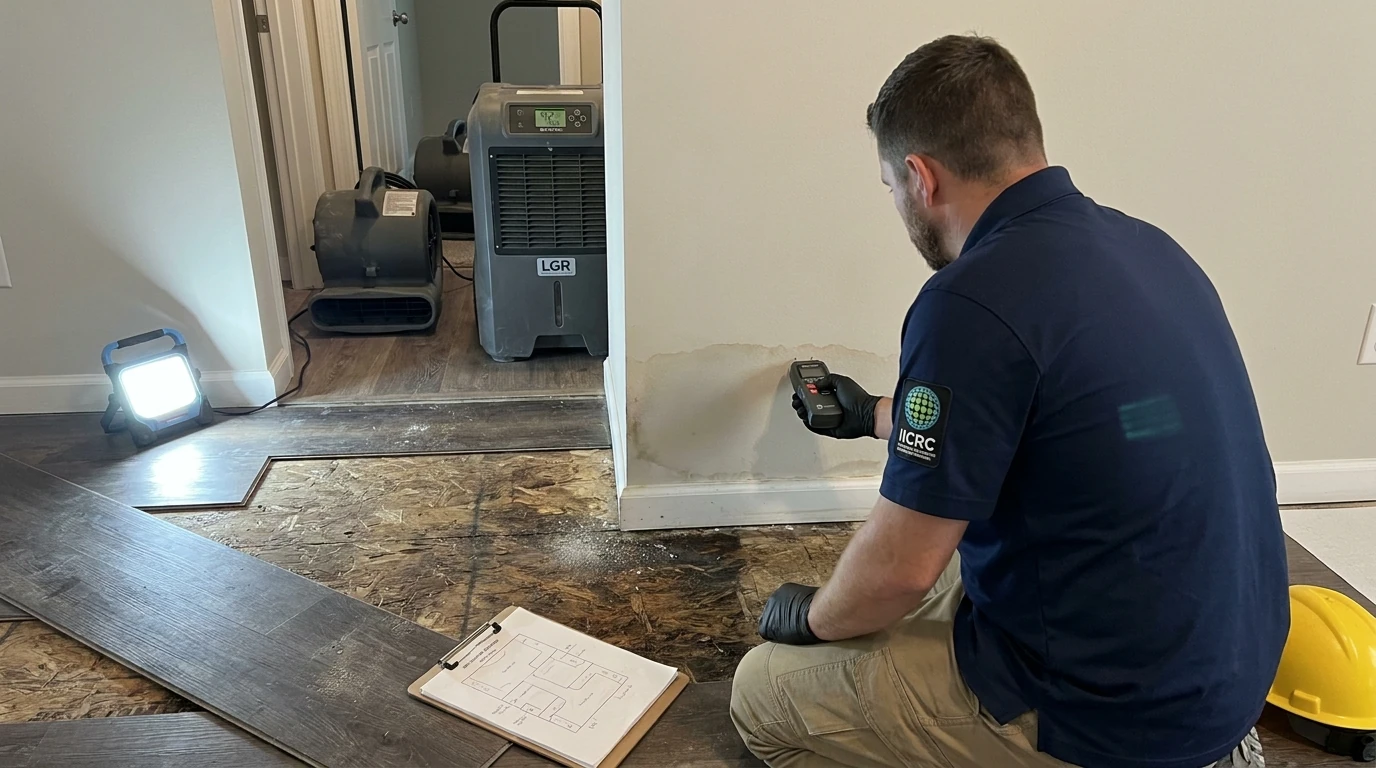
Hidden moisture migration. Water follows gravity and air pressure differentials. A leak that appears confined to one room often travels inside wall cavities, under flooring, and into adjacent spaces. Thermal imaging cameras and pin-type moisture meters reveal the true extent, which is frequently larger than the visible damage. Scope creep on a water job is usually real, not inflated.
Mold discovery during drying. If a leak was slow or went undetected, mold colonies may already be present inside wall cavities. Once found, the job scope expands to include mold remediation, which adds cost but also adds protection against long-term structural damage and air quality issues. In Alabama’s humid summers, mold can establish in as little as 24-48 hours in a wet wall cavity. If your job involves any period of undetected moisture, budget for the possibility of mold work.
Sewage or floodwater contamination. Any time the water source is a drain, toilet, or outdoor flooding event, you’re dealing with Category 3. The disposal requirements for Category 3-contaminated materials are more stringent, labor costs are higher due to PPE requirements, and the antimicrobial treatment protocol is more intensive. Jobs that start as Category 1 and are not addressed promptly can escalate to Category 3 classification.
Structural material type. Homes with hardwood floors, plaster walls, or finished basements cost more to restore than homes with carpet, drywall, and concrete subfloors. Not because the work is more complicated in every case, but because the drying equipment requirements and the replacement material costs are higher.
How to Evaluate an Estimate
A professional restoration estimate should itemize: the water category classification and basis for that classification, the affected square footage (with a moisture map or diagram), the equipment to be deployed and the projected drying duration, the monitoring schedule, and a clear separation between restoration scope and reconstruction scope.
If an estimate gives you a single lump number without those line items, ask for the breakdown. You need to know what you’re paying for, and your insurance adjuster will need the same documentation if you file a claim.
For most jobs in the $2,000 to $6,000 range, the decision between filing a claim and paying out of pocket comes down to your deductible, your claims history, and whether the source of loss is covered under your specific policy. Sudden and accidental losses (burst pipe, appliance failure) are typically covered. Gradual leaks and flooding from outside are typically not. The homeowners insurance coverage breakdown covers this in detail.
For an accurate scope and written estimate on a water damage job in Madison, Huntsville, or the surrounding area, Davis Construction Contractors offers assessments for residential and commercial properties. You can reach the team at (256) 771-0326 or request an estimate through the water damage restoration service page.